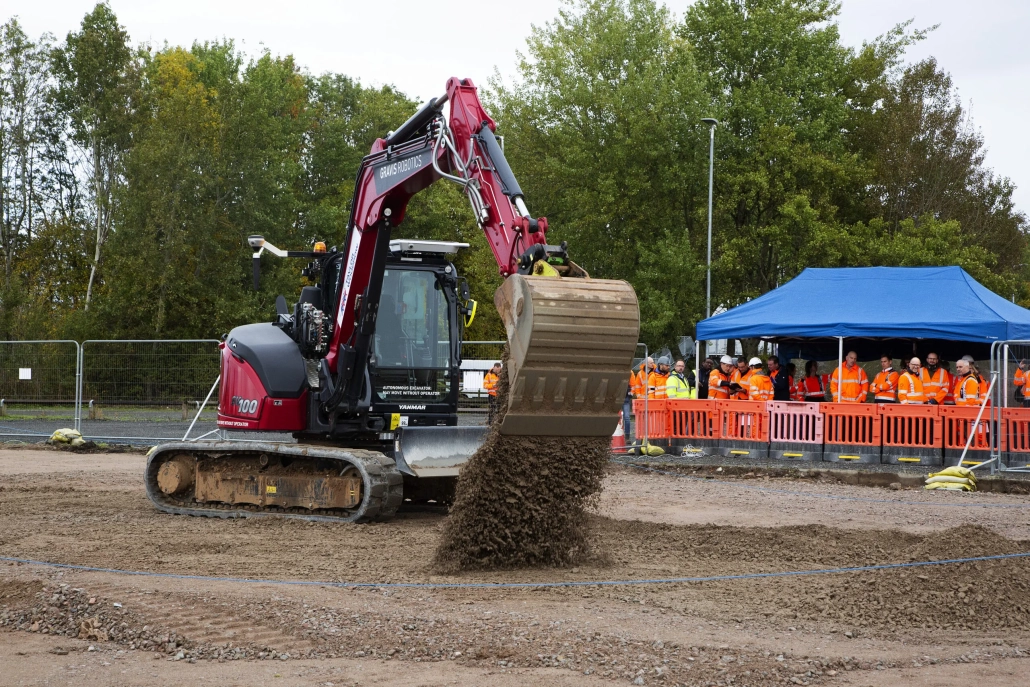
UK’s First Autonomous Excavator Revolutionises Manchester Airport Car Park Construction
The UK has witnessed a significant leap in construction technology with the successful trial of the nation’s first autonomous excavator at Manchester Airport. Developed through a collaboration between robotics firm Gravis and contractor Taylor Woodrow, the AI-powered machine is set to transform how car parks and other infrastructure are built.
Key Takeaways
- The UK’s first autonomous excavator, the SV100-7, has been trialled successfully.
- The technology uses AI and 3D models to perform digging tasks with high precision.
- It aims to improve safety, productivity, and address workforce shortages in the construction industry.
- A qualified human operator will still oversee the machine’s operation.
The Autonomous Excavator In Action
The autonomous excavator, model SV100-7, operates using a sophisticated system mounted on the machine, linked to a tablet and camera. By uploading 3D or CAD models of the desired excavation, the excavator can automatically dig trenches to precise specifications, such as pipelaying standards. During trials, the machine demonstrated its ability to dig trenches without human intervention after the initial command was given, even navigating around pre-existing underground pipes.
Addressing Industry Challenges
Phil Skegg, managing director of Taylor Woodrow, highlighted the technology’s potential to combat persistent issues in the construction sector. “Over the last 10 years our industry safety record has not improved, and our productivity has declined,” he stated. “We believe that increasing the mechanisation and automation of the tasks we undertake on site will help address these problems, removing people from danger, being more productive and improving quality of workmanship.”
Advanced Technology and Safety Features
Gravis CEO Ryan Luke Johns explained the AI’s role in adapting to dynamic ground conditions. “A human does a very good job at adapting to those small nuances in the ground and that’s what we’re doing using AI,” he said. The system uses sensors and hydraulic feedback to understand and adapt to varying soil consistencies, including rocky or frozen ground. Real-time LiDAR mapping allows for precise excavation and autonomous manoeuvring. Crucially, the machine incorporates safety measures, including a safety shield solution with image recognition that triggers loud warnings if a person enters the machine’s proximity, allowing for immediate stops.
The Human Element Remains Crucial
Despite its autonomous capabilities, both Gravis and Taylor Woodrow emphasize that a qualified excavator operator will oversee the machine. This “computer control machine controller” is responsible for uploading models and initiating the digging process, ensuring a human remains in the loop for critical decisions and safety oversight.
Future Deployment
Following extensive trials and refinements over several weeks, the autonomous excavator is slated for deployment on a live construction site at Manchester Airport, specifically for the Clough Bank B car park project. Gravis anticipates the SV100-7 will move into commercial testing in 2026. Taylor Woodrow is also exploring other autonomous machinery, including a drilling robot at a site in Newcastle.
Sources
- Watch: UK first trial of autonomous excavator helping to build car park at Manchester Airport, New Civil Engineer.
- Video | Taylor Woodrow trials AI-powered autonomous excavator, Construction Management Magazine.
- Taylor Woodrow successfully trials UK first AI autonomous excavator, New Civil Engineer.
- Driverless digger to be used on Taylor Woodrow site, Construction Enquirer.